My Chronic Illness Travel Kit. What I Wish I Packed for a 6 Hour Trip
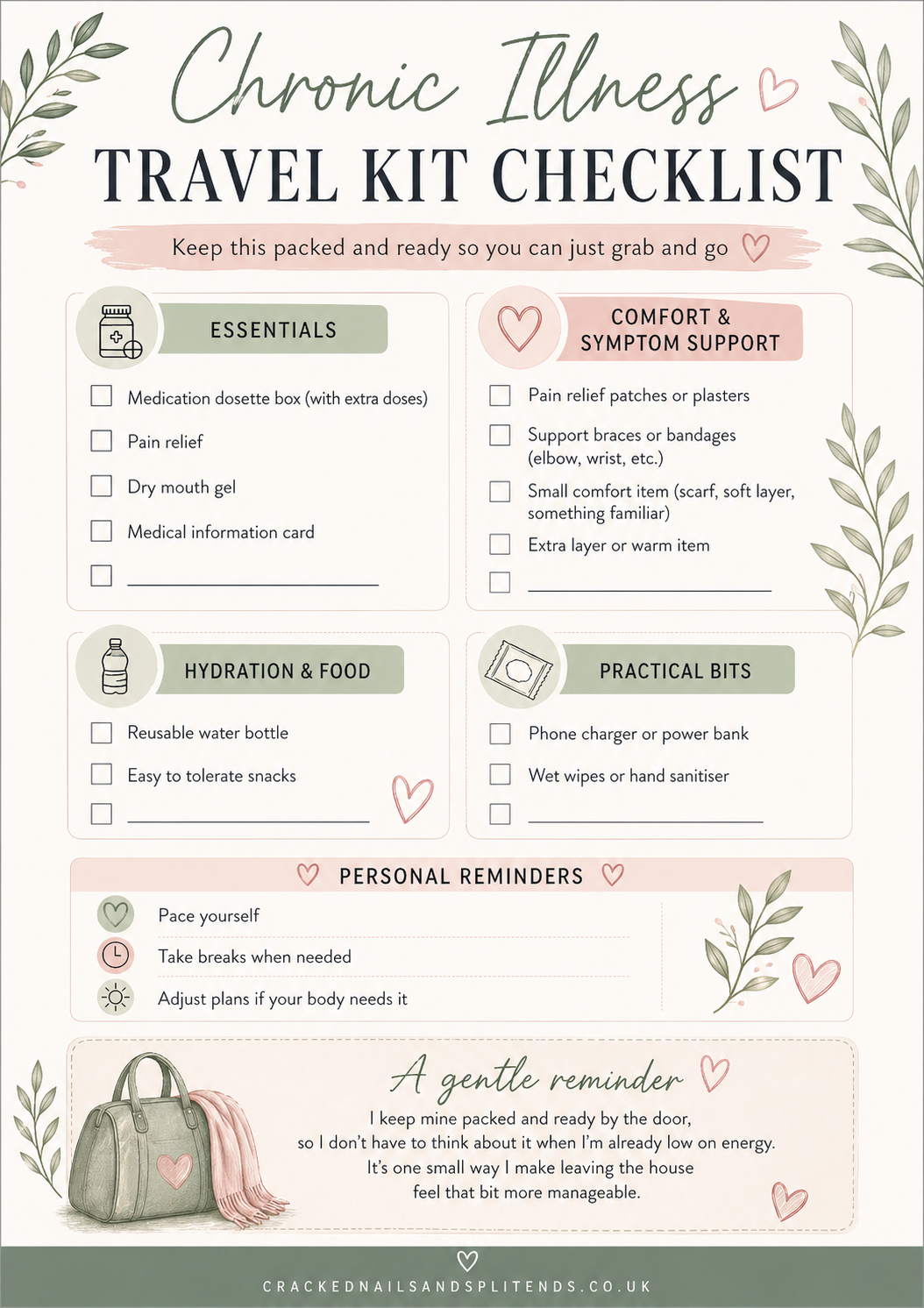
My Travel Kit. Learning the Hard Way After a Six Hour TMJ Trip
I had my TMJ appointment the other day, which is a six hour round trip. The kind of day that sounds manageable when you first say yes to it, and then quietly unravels your energy, your pain levels, and your patience as the hours tick by.
I thought I had prepared well enough.
I packed my afternoon medication. I had my ninja water bottle with me. I remembered my mouth gel for the dry mouth that always creeps in when I am out for too long. I even had a pain plaster tucked in my purse as a backup for my neck.
And yet, somewhere between planning and reality, it still went wrong.
That is the thing about living with ME CFS and fibromyalgia. You can prepare, you can plan, you can try to stay ahead of your symptoms, but it only takes one small oversight for the whole day to tip into something much harder than it needed to be.
The Pain Plaster That Failed Me
I have been carrying that pain plaster around for weeks.
It lives in my bag like a kind of comfort blanket, one of those just in case things that makes me feel a little more in control and reassured in case the pain flares up when I am out of the house.
Except today, when I actually needed it, it did not work.
There was no warmth. No gradual easing. Nothing.
Just the same deep, nagging neck pain that had been building from sitting upright for too long, from the travel, from the appointment itself.
And I realised why.
I had taken it out of the silver sealed packaging weeks ago and just slipped the plaster into my purse. I did not think twice about it at the time. It felt more convenient, quicker to grab if I needed it.
But those plasters rely on that sealed packaging to stay effective. Without it, they slowly lose what makes them work in the first place.
So when I needed relief the most, it simply was not there.
And I had to sit through the rest of the journey home feeling every single bit of that pain.
The Bigger Mistake. No Proper Medication
The plaster not working was frustrating, but what really made the day harder was something else entirely.
I had not packed any actual medication.
No cocodamol. No backup pain relief. Nothing.
It sounds so obvious when I write it down, but in the moment, I had convinced myself I would be fine. That the appointment would not be too much. That I could manage.
That kind of thinking is something I have written about before in my pacing struggles, and it still catches me out.
There is always that quiet hope that maybe this time my body will cope better than expected.
And sometimes it does.
But when it does not, you feel it.
When Preparation Is Not Quite Enough
I did not completely fail at preparing.
I had my water, which is essential for me. Hydration makes such a difference, especially when fatigue and pain are already high.
I had my mouth gel, which helped with the dryness that always seems to hit when I am out for long periods.
I had my afternoon medication, which at least kept part of my routine steady.
But what I did not have was a proper system.
Everything I took was more of a last minute grab than a thought through kit. There was no structure, no checklist, no consistency.
And that is where I need to change things.
Why I Need a Proper Medical Travel Kit
Today made something very clear to me.
I do not just need to remember a few things when I leave the house.
I need a dedicated medical travel kit.
Something that lives ready. Something I can grab without thinking. Something that does not rely on how I am feeling that day or how rushed I am.
Because the reality of ME CFS and fibromyalgia is that our capacity is already limited.
Decision making takes energy.
Remembering things takes energy.
Even packing a bag can take more out of you than you expect.
So the less I have to think in those moments, the better.
What Will Be in My Travel Kit Going Forward
I have already started mentally building what this kit needs to include.
My pain relief is at the top of the list. That is non negotiable now. Cocodamol will have a permanent place in there.
A properly sealed pain plaster will also stay, but this time it will remain in its original packaging until I need it. Lesson learned.
My mouth gel is staying. That small bit of comfort made a difference today.
My water bottle will always come with me, but I may also add electrolyte sachets for longer trips. Something to help with that drained feeling that creeps in after a few hours.
I also need to include my support bandages, like my elbow support. This is something I often forget until I actually need it, and by then it is too late. When pain flares or joints start to feel unstable, having that physical support can make such a difference to how manageable the rest of the day feels.
I am also thinking about adding things like a small heat pack that does not rely on being freshly opened, or at least making sure I understand how long they stay effective once opened.
Snacks are another one. I did not mention it earlier, but long journeys and appointments can leave me feeling shaky if I do not eat properly.
And then there are the quieter comforts.
Things like a soft scarf or neck support. Something to make sitting for long periods a little less painful.
These are the kinds of additions that seem small but can change how manageable a day feels.
The Emotional Side of It All
There is also something else that does not get talked about enough.
The emotional frustration of days like this.
It is not just the physical pain.
It is the knowing that things could have been easier if you had just packed one more item. If you had thought one step ahead.
That kind of frustration can sit heavy, especially when you are already exhausted.
But I am trying to shift how I see it.
Instead of seeing today as a failure, I am choosing to see it as information.
It showed me exactly where the gaps are.
And now I can fix them.
Building Systems That Work With Chronic Illness
Living with chronic illness means learning to build systems that support you on your worst days, not just your best ones.
That is something I have touched on in my other posts about managing daily life with ME CFS and fibromyalgia, and it applies here just as much.
A travel kit is not just about convenience.
It is about reducing risk.
It is about protecting your energy.
It is about giving yourself the best possible chance of getting through a day without unnecessary suffering.
And most importantly, it is about being kind to yourself in a practical way.
Travel and Chronic Illness. The Reality
Travel, even short trips, can be one of the most draining things when you live with conditions like this.
The sitting, the waiting, the noise, the unpredictability.
It all adds up.
That is why I have been slowly building more awareness around what I need when I leave the house. It is something I have also explored in my post about aid items for holidays, because the same principles apply even on smaller scales.
Preparation is not about overdoing it.
It is about giving yourself options.
What I Will Do Differently Next Time
Next time I have an appointment like this, things will look different.
My medical travel kit will already be packed.
My medication will be there without me having to think about it.
My pain relief options will actually work.
My support bandages will be there ready when my body needs that extra help.
And I will not be relying on memory or last minute decisions.
Because if today taught me anything, it is this.
When you live with chronic pain and fatigue, the smallest gaps in preparation can become the biggest problems.
And the simplest systems can make the biggest difference.
A Gentle Reminder to Myself
I am not writing this as someone who has it all figured out.
I am writing this as someone who is still learning.
Still adapting.
Still getting it wrong sometimes.
But also slowly, steadily, building a way of living that supports me better.
If you are anything like me, you have probably had days like this too.
Days where you thought you had everything covered, and then something small slipped through.
It happens.
But those days can also be turning points.
Because they show you exactly what you need to change.
And for me, that change starts with one simple thing.
A proper, ready to go, medical travel kit.
About me
I am a married mother of four children. One of those children is our granddaughter, for whom we are legal guardians and kinship carers. I run a small business, and I love to write, which is how this blog came to be. I write about family life, kinship care, and my experiences living with chronic illness and disability, including ME CFS, spinal stenosis, TMJD, chronic pain, and fibromyalgia. I am also very aware that I am doing all of this in my mid-forties, which still surprises me some days.
You’re not alone here. You’re welcome to stay as long as you need.
FAQ: Chronic Illness Travel Kit
-
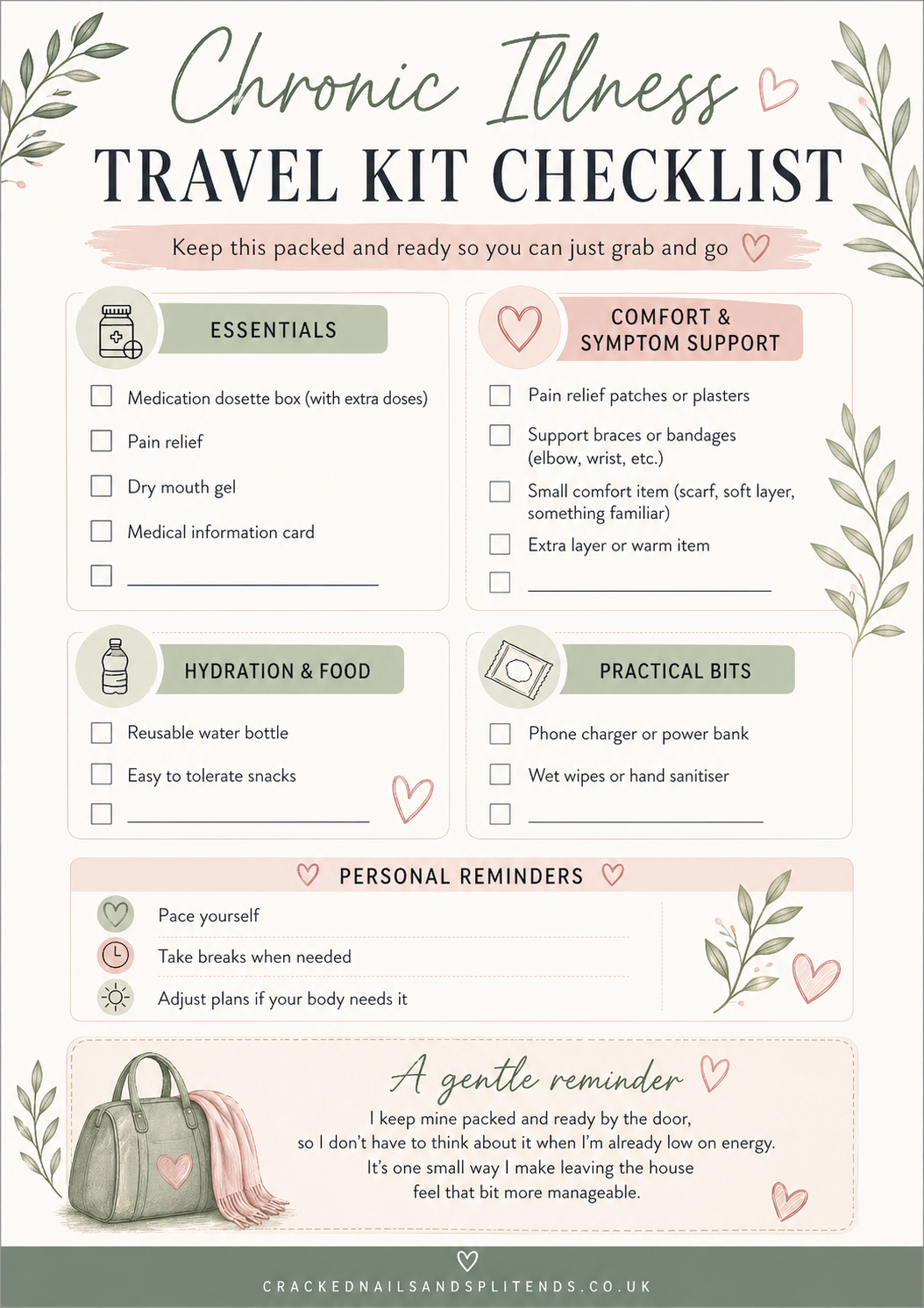
For me, it is all about covering the basics so I am not caught off guard. I always pack my medication, pain relief, a water bottle, snacks, and anything that helps manage my symptoms like supports or patches. It does not need to be complicated, just the things you know your body might need.
-
Because energy is limited, and preparation takes more out of me than it used to. Having a kit already packed means I am not rushing around before I leave or trying to remember everything through brain fog. It makes leaving the house feel much more manageable.
-
I keep mine simple. A small bag with sections works best so everything has its place. I tend to group things into essentials, comfort items, and practical bits so I can find what I need quickly without digging around.
-
That is completely fine. I do not always use everything either. It is there for reassurance as much as anything else. I would rather have it and not need it than be stuck without something when I do.
-
I try to check mine once a week or before a longer trip. I make sure medication is topped up, nothing has run out, and everything is still relevant to how I am feeling at the moment.
-
Absolutely. This is just what works for me. Everyone’s needs are different, especially with chronic illness. Your kit should reflect your symptoms, your routine, and what helps you feel most supported when you are out.
This is based on my personal experience and is not medical advice. Always check with a healthcare professional for guidance that is right for you.