Blue Badge Abuse and Disability Harassment: What To Do If You Are Attacked
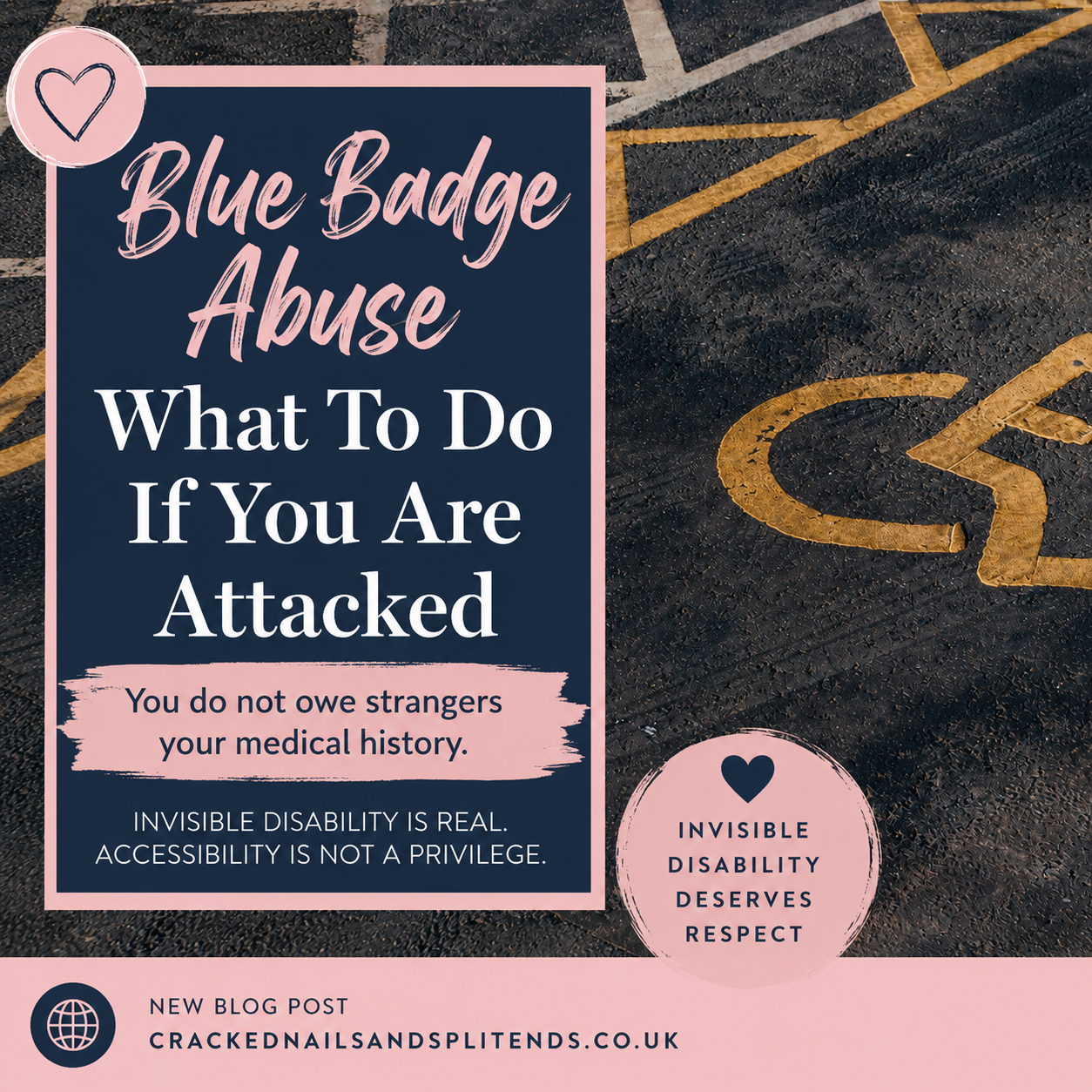
Something really bothering me is happening right now in the UK when it comes to disabled people. You can see it everywhere, online, in newspaper headlines, in comments, and sometimes it even hits you when you're just trying to mind your own business in a supermarket car park.
With all the talk lately about PIP, cutting benefits, disability checks, mobility cars, and those 'benefit fraud' stories in the news, it feels like people have become much more hostile towards disabled people. This is especially true for those of us with conditions you can't see.
I have a Blue Badge myself, though I don't drive anymore because of my ME CFS and fibromyalgia. I only use it when my husband is taking me places. Luckily, no one has ever directly bothered me when I've used it, but to be fair, I think that's partly because I hardly ever leave the house these days. Between the bad fatigue, pain, sensory overload, and PEM, my world is already really tiny.
Even with that, I still worry about it. Maybe more than I should sometimes.
I worry because disabled people are increasingly being shown as burdens, cheats, lazy, or just not deserving of help. I worry because people now feel like it's okay to question disabled strangers out in public. And I worry because so many people still don't get that not all disabilities are obvious to see.
One thing I keep seeing a lot is how confused people are about Blue Badges and Motability cars. It seems like people just assume that if you have a Blue Badge, you automatically have a mobility car too. But that's just not how it works.
Lots of disabled people with Blue Badges don't have a Motability car at all. Some can't drive anymore. Some rely on their partners or people who help care for them. Some use cars belonging to their family. Some only go out for doctor's appointments. A Blue Badge is about making things easier to access, not about having to prove you're disabled to random people.
But sadly, we're now hearing more stories about people getting verbally abused, being followed around and filmed, accused of 'faking it,' yelled at in car parks, confronted for using disabled parking spots, and sometimes even physically attacked.
Honestly, something like that would probably stick with me for days. I already overthink things enough as it is, without also having to deal with public confrontations.
So, I wanted to put this post out there for anyone who might face disability harassment, misuse of their Blue Badge, or ableist remarks when they're out in public. It's not about saying you should have to prepare for such things. Instead, it's because disabled people really ought to have support, practical tips, and the clear understanding that none of this is ever their fault.
Just remember, you don't have totellstrangersabout your health issues.
This is probably the main point I want to get across.
You really don't need to explain your disability to just anyone you meet.
Not every disability is something you can see. Things like ME CFS, fibromyalgia, nerve problems, heart issues, constant pain, autism, Crohn's disease, serious mental health struggles, and so many others might not be clear just by looking at someone.
It seems some folks quickly assume you're faking if you can take a few steps or don't 'look sick enough.' Honestly, that's just silly.
That's just them being uninformed, not actual proof.
You don't have to explain why you have a Blue Badge.
You don't have to share your diagnosis.
And you definitely don't need to prove how much you're hurting to some random people in a parking lot.
What happens when someone throws a snarky comment your way?
Sadly, a lot of these situations kick off with just a few words.
You know the kind of thing:
“You don’t look disabled.”
“That badge belongs to someone else.”
“You’re taking spaces from real disabled people.”
“You walked fine.”
Sometimes it’s a quiet mutter under their breath. Other times, though, it feels like they’re actively looking for a fight. And then there are those who honestly think disability fraud is rampant, so they try to publicly shame anyone they suspect.
When this happens, remember: your safety always, always comes first. It’s more important than winning an argument, hands down.
If you feel genuinely safe enough to respond, a calm, straightforward answer is all you need:
“I have a valid Blue Badge.”
Or:
“Not all disabilities are visible.”
You really don’t have to say another word after that.
And honestly, especially with something like ME/CFS, even a little stress can send me into a full-blown crash. That adrenaline rush? It can completely wipe me out for days. Even a tough conversation can leave me shaking, utterly exhausted, and aching for hours afterward. So, looking out for your nervous system is a huge deal.
Sometimes, walking away is truly the best thing you can do for yourself, especially when you know deep down that the stress itself is just going to trigger those symptoms later on.
If Somebody Starts Filming You
It feels like this is happening more and more these days, doesn't it? Especially with social media culture encouraging people to "expose" others publicly.
Being filmed, particularly when you live with a disability, can leave you feeling deeply humiliated and pretty scared.
If you ever find someone pointing a camera at you:
Try your best not to let panic take over.
Whatever you do, don't get physical.
If it's possible, head towards a public spot where other people are around.
And if you're with someone, make sure you stick together.
You can say, calmly:
"Could you please stop filming me?"
Or maybe:
"I really don't agree to being filmed in a way that feels like harassment."
Here in the UK, it's a bit complicated. People often have the legal right to film in public spaces. But that's a world away from harassment, trying to intimidate someone, any kind of threatening behaviour, or specifically targeting someone with abuse. Those situations are completely different.
If you start to feel unsafe, your absolute priority should be finding a secure place, not getting into an argument.
If You Feel Physically Unsafe
If somebody is aggressive, blocks your path, threatens you, follows you, or becomes physically intimidating, take it seriously.
Disabled people are often conditioned to minimise abuse or avoid “making a fuss”, but your safety matters.
If possible:
Get back into the car.
Lock the doors.
Call somebody you trust.
Move towards security staff or busy public areas.
Call the police if you feel threatened.
If somebody physically assaults you, report it.
I know many disabled people avoid reporting incidents because we are exhausted, overwhelmed, anxious about not being believed, or simply do not have the energy for long processes. I completely understand that.
But disability related harassment and assault are not acceptable.
Keeping Your Blue Badge Out in the Open and Up-to-Date
Look, this is really just some practical advice, but honestly, making sure your Blue Badge is displayed properly can really save you a lot of hassle.
Just give it a quick once-over:
Is the badge easy to see?
Has it perhaps passed its expiry date?
Are all the details facing the right way?
And is that clock properly set if you need it?
It’s a real shame, but sometimes arguments kick off simply because folks just assume a badge is being used improperly.
Ableism's Real Impact: It Can Be Traumatic
You know, I don't think we really talk enough about the emotional toll ableism takes.
When you're already spending your days just trying to get the healthcare you need, constantly fighting against people who don't believe you, managing your symptoms, carefully pacing your energy, dealing with endless assessments, stressing about money, and just trying to survive life with a chronic illness, then public hostility really hits hard. It cuts deep.
It can seriously make you scared to even step out of your front door.
That feeling can ramp up your anxiety.
It might even make your PEM or other flare symptoms worse.
And you can end up replaying those moments over and over in your head for days.
For me, my world has already shrunk so much because of ME CFS and fibromyalgia. The thought of also being judged or having someone confront me simply for needing accessibility support? Honestly, it just makes the idea of being out in public feel even more draining.
And looking at what people are sharing online recently, it seems like so many other disabled folks are experiencing this exact same thing.
Honestly, It Just Feels Like Things Have Shifted Recently
I think if you're disabled, you can probably feel this change in the air.
All the talk we hear constantly, about "scroungers," about benefits, fraud investigations, welfare reform, and cutting support, it really fosters an environment. It makes strangers feel like they're somehow entitled to start policing disabled people on their own.
It breeds a lot of suspicion.
It stirs up resentment.
And it puts vulnerable individuals at risk, people just trying to navigate public spaces.
Most disabled people are already quietly battling so much behind closed doors, things the general public never even glimpses.
A lot of us are simply surviving, not really living fully.
So many of us would trade anything to get our health back.
What I Tell Myself to Stay Grounded
Personally, I really try to keep these thoughts at the front of my mind:
Just because some stranger is ignorant doesn't make my disability any less real.
I know exactly how much I fight through, day in and day out.
I live with the constant pain, the crushing fatigue, the sensory overload, the PEM, the insomnia, the physical weakness, the brain fog, and all the other limitations. I know it all intimately.
And the folks who truly matter in my life? They get it. They already understand.
Sometimes, it seems the loudest voices belong to those who've never actually gone through chronic illness, disability, or vulnerability themselves.
Support Matters
If you ever find yourself facing disability harassment, please, don't keep it to yourself. Talk about it.
Reach out to someone you really trust.
If it feels right, share your experience within disability communities online or in person. It can sometimes help just to connect.
You are absolutely not overreacting just because you're upset.
Feeling shaken doesn't make you weak.
And most importantly, you are definitely not alone in this.
Just living with a chronic illness demands immense strength every single day as it is.
Having to also constantly defend your need for accessibility on top of all that? That's really something no one should ever have to go through.
If you are living with ME CFS, fibromyalgia, or invisible illness too, you may also relate to my post about URL: the emotional toll of appointment fatigue with chronic illness and URL: life with chronic illness on low energy days outside the house.
About Me
I am a married mother of four children. One of those children is our granddaughter, for whom we are legal guardians and kinship carers. I run a small business, and I love to write, which is how this blog came to be.
I write honestly about family life, kinship care, neurodiversity, and my experiences living with chronic illness and disability, including ME CFS, spinal stenosis, fibromyalgia, chronic pain, and TMJD.
If you have found yourself here feeling overwhelmed, exhausted, or simply looking for reassurance that you are not alone in this journey, you are always welcome here.

Frequently Asked Questions About Blue Badge Abuse and Invisible Disability
-
Unfortunately yes, people sometimes do question disabled people using Blue Badges, especially if they have an invisible illness. However, you do not owe strangers your medical history or proof of your disability. If your Blue Badge is valid and correctly displayed, you have every right to use accessible parking spaces.
-
If somebody makes rude comments or challenges you, try to prioritise your safety and wellbeing. You can calmly say that not all disabilities are visible, but you are not obligated to explain your condition. If the situation feels unsafe or overwhelming, walking away is completely okay.
-
People can sometimes film in public places in the UK, but harassment, intimidation, and threatening behaviour are different matters. If somebody is following you, aggressively filming you, or making you feel unsafe, try to move to a public area, seek help if needed, and contact the police if you feel threatened.
-
No, not at all. Many disabled people with Blue Badges do not have a Motability vehicle. Some people cannot drive anymore due to chronic illness or disability and rely on family members, carers, or partners for transport.
-
Yes. Many invisible illnesses and chronic conditions can qualify for a Blue Badge in the UK, including neurological conditions, chronic pain disorders, severe mobility limitations, and illnesses like ME CFS and fibromyalgia where walking causes significant difficulty, pain, or exhaustion.
-
Many disabled people feel there has been a rise in hostility due to media narratives around benefits, disability support, PIP assessments, and fraud stories. Sadly, this has contributed to increased judgement and suspicion towards disabled people, especially those with invisible disabilities.
Disclaimer: This post is based on my own personal experiences and opinions living with chronic illness and invisible disability. It is not legal or medical advice. If you feel unsafe, threatened, or physically attacked, please seek appropriate support or contact the relevant authorities.