Why It Is Important That Children Experience Being Bored Often
If you are reading this, you are probably part of the unique and often exhausting world of kinship care, special guardianship, or parenting neurodiverse children. You know the emotional load that comes with trying to meet everyone’s needs while holding the whole household together. You know what it feels like to constantly think three steps ahead, trying to prevent meltdowns, dysregulation, boredom, conflict, or overwhelm before they even happen.
For a very long time, I believed that if my children were quiet, it meant they were happy. If they were occupied, it meant they were learning. If they were entertained, it meant I was doing a good job.
I think a lot of us carry that pressure without even realising it.
I remember one afternoon where the house had finally gone quiet for a few minutes. My child had started pacing around the living room saying they were bored, and I could feel myself immediately going into problem solving mode. My hand almost reached for the tablet before I stopped myself. I remember standing there thinking, why am I so uncomfortable with them having nothing to do?
That moment stayed with me because I realised the discomfort was not just theirs. It was mine too.
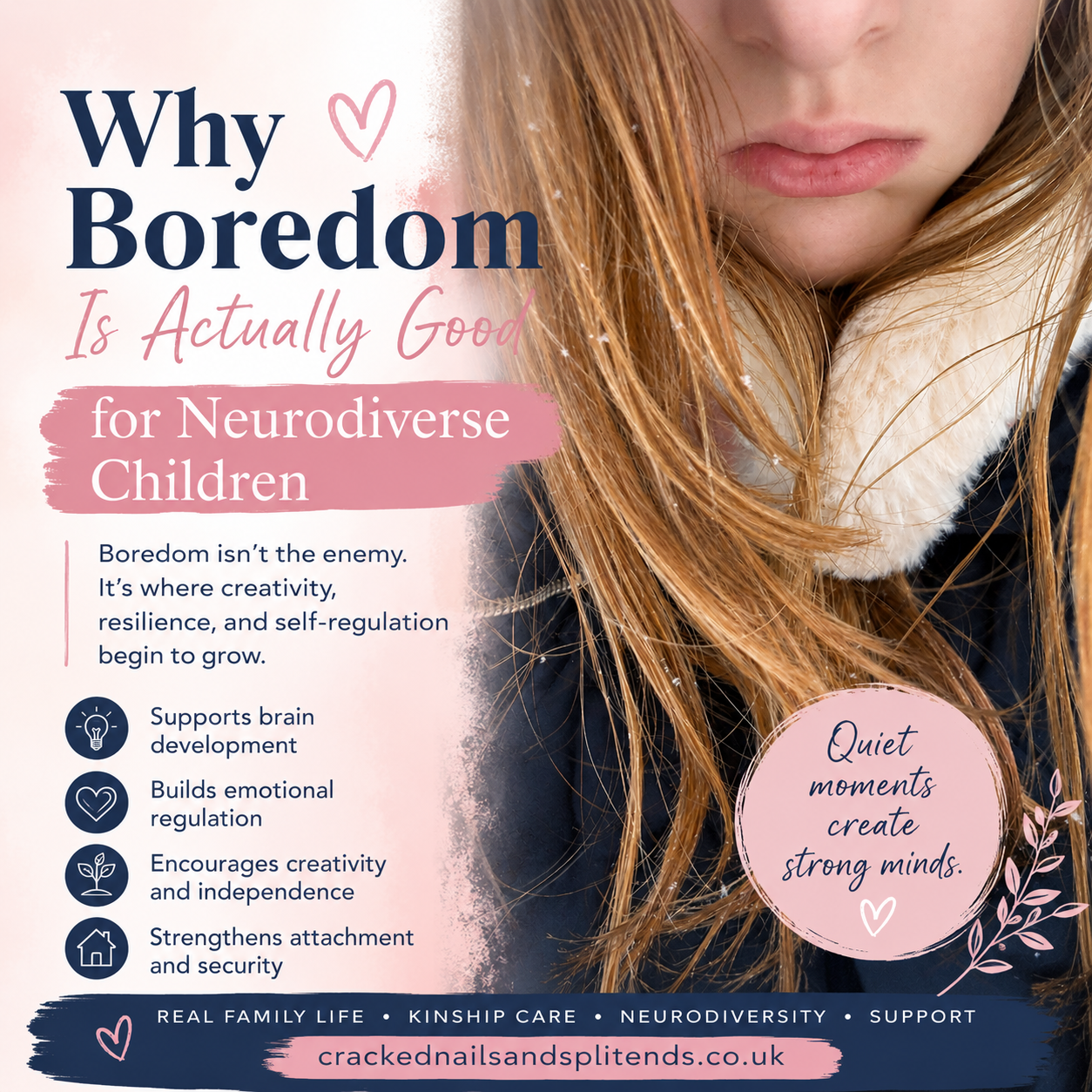
Over the years, I have started to understand something that felt completely backwards at first. Boredom is not the enemy. In fact, boredom can actually be incredibly important for our children, especially children who are neurodiverse or who have experienced trauma and instability early in life.
What looks like “doing nothing” is often the exact thing their brains and nervous systems need most.
What Boredom Actually Looks Like In Our Homes
When most people think about boredom, they picture a child sighing dramatically or complaining that there is nothing to do. But for many of our children, boredom can look very different.
For children with ADHD, autism, sensory differences, trauma histories, or attachment difficulties, unstructured time can feel genuinely uncomfortable. Sometimes even frightening.
Instead of quietly daydreaming, boredom might look like:
hyperactivity
emotional outbursts
sensory seeking behaviour
picking arguments
climbing furniture
creating chaos
shutting down completely
Because many of our children live with nervous systems that are already running at full volume, empty space can feel overwhelming. Silence can feel uncomfortable. Stillness can feel unsafe.
I know there were years where I rushed to fill every quiet moment because I thought I was helping. Quick, let’s go somewhere. Here’s a snack. Let’s do crafts. Watch a film. Go outside. Anything to stop the discomfort before it escalated.
I genuinely believed I was supporting them.
But slowly, I realised I was accidentally teaching them something else entirely. I was teaching them that uncomfortable feelings had to be escaped immediately. That boredom was something unwelcoming. That they needed external stimulation in order to cope.
And honestly, I think many of us do this because we are exhausted ourselves. Sometimes keeping children constantly occupied feels easier than dealing with what might happen if we do not.
Why The Brain Actually Needs Boredom
One of the things I have learned through parenting neurodiverse children is that the brain cannot constantly absorb input without eventually becoming overloaded.
Our children are surrounded by stimulation all day long. Screens, school demands, noise, conversations, transitions, social expectations, notifications, activities, and constant information coming at them from every direction.
There is very little true quiet anymore.
But the brain actually needs quiet spaces in order to process information properly.
The human brain is designed to seek patterns, solve problems, imagine, create, and organise thoughts internally. Those things do not happen well when the brain is constantly being entertained.
Boredom is essentially the brain’s way of saying it is time to sort through the files.
That line changed the way I viewed empty time completely.
When children are allowed space without instant entertainment, something important begins to happen. Their brains slowly shift out of reactive mode and into creative mode. They begin exploring ideas, building internal motivation, solving problems independently, and learning how to tolerate stillness.
For neurodiverse children especially, this matters enormously.
Many neurodivergent children think deeply and creatively, but they also often struggle with processing overload. If their minds are constantly filled with outside input, they never get the chance to organise their own thoughts internally.
Quiet moments allow their brains to breathe.
Boredom Builds Emotional Regulation
One of the hardest things for many children to learn is that uncomfortable feelings are survivable.
Boredom feels uncomfortable. Frustration feels uncomfortable. Restlessness feels uncomfortable.
But those feelings are not dangerous.
When we rush in immediately to fix boredom, we unintentionally teach children that discomfort must always be removed straight away. Over time, this can make frustration tolerance even harder.
Allowing children to experience manageable amounts of boredom helps build emotional regulation slowly and safely.
They begin learning:
that feelings come and go
that they can survive discomfort
that they are capable of solving problems themselves
that they do not need constant stimulation in order to feel okay
For children in kinship care or special guardianship arrangements, this can be especially powerful.
So many of our children have experienced situations where they had little control over their own lives. Decisions were made around them constantly. Giving them ownership over their own free time can actually help rebuild confidence and independence.
Instead of us constantly directing every moment, boredom says:
“This time belongs to you.”
That sense of autonomy matters more than we sometimes realise.
Creativity Lives In The Quiet Moments
Some of the most creative moments I have ever seen from my children have happened after boredom.
Not during organised activities.
Not during screen time.
Not when I had planned something special.
It usually starts with complaints first.
Then pacing.
Then dramatic declarations of having “nothing in the whole world to do.”
Then eventually, something shifts.
A game appears.
A project begins.
A lego set is built.
Someone
Someone starts drawing.
Someone disappears into a book for two hours.
And the beautiful thing is that it is entirely theirs.
Creativity needs space. It needs wandering thoughts. It needs moments where the brain is not being directed every second.
I think this is especially important for neurodiverse children because so many of them struggle inside rigid systems. School often focuses heavily on structure, rules, and outcomes. But when they are given freedom to explore their own interests naturally, their strengths often shine in incredible ways.
Sometimes the most important thing we can do is simply step back.
Boredom Can Strengthen Attachment Too
This part surprised me the most.
I used to think good parenting meant constant engagement. I felt guilty if I was not actively interacting, teaching, entertaining, or supporting every moment of the day.
But over time, I realised something important. Children do not need us to perform constantly in order to feel loved and secure.
In fact, always becoming the entertainer can sometimes create even more dependency.
When we allow children space to wander off into their own imagination while we remain emotionally available nearby, we become their secure base instead of their constant source of stimulation.
That is a very different dynamic.
They learn:
that we are present even in quiet moments
that silence does not mean rejection
that independence is safe
that connection still exists without constant interaction
For children who have experienced instability or loss, this can be incredibly healing.
It teaches them that relationships do not disappear when the room goes quiet.
And honestly, it also takes pressure off us as parents.
We are already carrying so much. The emotional responsibility of parenting children with additional needs can feel relentless at times. Allowing boredom into the home means recognising that we do not have to carry the role of entertainer every second of the day too.
Sometimes it is okay to drink your tea while your child complains they are bored.
Sometimes that quiet space is exactly what everybody needs.
How To Encourage Healthy Boredom
I know this all sounds lovely in theory, but I also know the reality. For some children, completely unstructured time can quickly lead to dysregulation if introduced too suddenly.
The goal is not to remove all support overnight. It is about slowly building tolerance for quiet moments.
A few things that have helped in our home:
Start Small
You do not need to suddenly clear the calendar and remove every activity.
Start with ten minutes of unstructured time without screens or suggestions. Let them experience that feeling safely in small doses.
Resist Jumping In Immediately
This is probably the hardest part.
When your child says “I’m bored,” try not to immediately solve it for them. Pause first. Give them space to think.
That uncomfortable pause is often where creativity begins.
Create A Boredom Jar
We could use little jars filled with simple activity ideas before. Things like:
build a den
draw a comic
sort Lego by colour
make a snack
create a scavenger hunt
The important part is that they choose, not you.
Limit Constant Screen Access
I know screens have an important place, especially for regulation and downtime, and I am not anti screen at all.
But screens offer instant dopamine and instant stimulation. If they are always available, the brain never gets the opportunity to move through boredom into creativity naturally.
Embrace Slower Activities
Some of the best regulating activities are the quiet repetitive ones:
baking
gardening
walking
colouring
folding laundry
listening to music
playing with water
building things slowly
These activities create mental breathing space without overwhelming the nervous system.
Model Stillness Yourself
Children notice everything.
If we constantly rush around appearing stressed, busy, and overstimulated, they absorb that energy too. Showing them that rest, quiet, reading, sitting down, or simply thinking are all normal parts of life is incredibly valuable.
It Takes Time
If your children are used to constant stimulation, boredom will probably feel uncomfortable at first.
There may be pushback.
There may be testing.
There may be chaos before calm.
That does not mean you are doing something wrong.
It simply means their nervous systems are adjusting.
Try to remind yourself that allowing boredom is not neglectful. You are not failing them by refusing to fill every single moment. You are actually helping them develop independence, resilience, creativity, and emotional regulation.
Those are lifelong skills.
We want our children to grow into adults who can sit with themselves peacefully. Adults who can problem solve, self regulate, and tolerate quiet moments without panic.
And strangely enough, those skills often begin with something very small.
They start with a sigh.
They start with nothing to do.
They start with boredom.
About Me
I am a married mother of four children. One of those children is our granddaughter, for whom we are legal guardians and kinship carers. I run a small business, and I love to write, which is how this blog came to be.
I write honestly about family life, kinship care, neurodiversity, and my experiences living with chronic illness and disability, including ME CFS, spinal stenosis, fibromyalgia, chronic pain, and TMJD.
If you have found yourself here feeling overwhelmed, exhausted, or simply looking for reassurance that you are not alone in this journey, you are always welcome here.



Frequently Asked Questions
-
You are definitely not alone in this. Constant notifications, scrolling, brain fog, mental overload, and digital distractions can quickly pull your attention away from the original reason you unlocked your phone in the first place.
-
Absolutely. Living with brain fog, chronic illness, fatigue, or mental exhaustion can make it much harder to stay focused once notifications and apps start competing for your attention.
-
For many people, unread notifications can create a feeling of mental clutter or pressure sitting in the background. Even when trying to ignore them, your brain still knows they are there waiting to be dealt with.
-
Small changes can help, like turning off non essential notifications, setting screen time boundaries, or saying your task out loud before unlocking your phone. It is not always easy though, especially when your brain is already tired.
-
For many people living with chronic illness, ME/CFS, fibromyalgia, or fatigue, constant phone notifications and digital overwhelm can feel even more mentally draining because energy and concentration are already limited.
Disclaimer: This post is based on my personal experiences and is not intended as medical, legal, or professional advice.