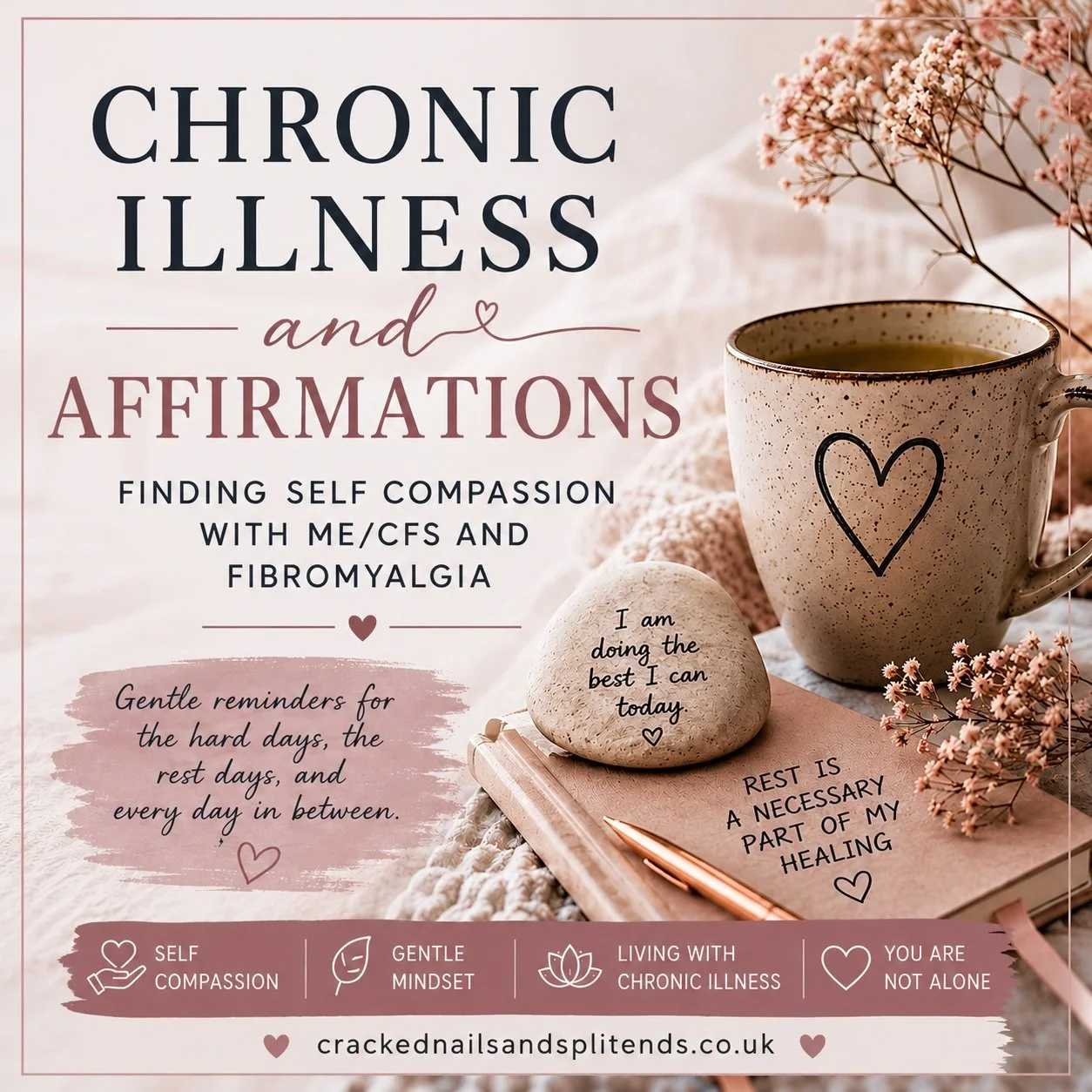
Chronic Illness and Affirmations: Finding Words That Support Me Instead of Shame Me
When I first came across affirmations, I will admit I wasn’t entirely convinced. Part of me wanted to believe in them, but another part of me was filled with doubt.
At the time, I was struggling to come to terms with life with ME/CFS and fibromyalgia. My world had become smaller, my energy was unpredictable, and I was carrying a level of grief that I did not yet have words for. Everywhere I looked online, affirmations seemed to focus on positivity, success, abundance, and becoming the best version of yourself.
The problem was that when you are living with chronic illness, especially conditions like ME/CFS and fibromyalgia, getting through the day can feel like an achievement in itself.
I did not need someone telling me I could do anything if I just believed hard enough.
I needed something gentler.
I needed words that acknowledged reality while offering comfort.
Over time, I realised that affirmations do not have to be about pretending everything is fine. They do not have to be about forcing positivity or ignoring difficult emotions. For me, affirmations became small reminders that I was still worthy, still valuable, and still deserving of compassion, even on the hardest days.
Why Traditional Affirmations Never Worked for Me
One of the biggest challenges I found with mainstream affirmations was that they often felt disconnected from my reality.
When you live with chronic fatigue syndrome or fibromyalgia, there are days when your body simply will not cooperate, no matter how motivated you are. There are days when pain levels are high, brain fog is overwhelming, and even basic tasks require careful pacing.
Telling myself things like “I am limitless” or “I can achieve anything I set my mind to” often left me feeling worse rather than better.
Not because the statements were inherently bad, but because they created a gap between what I was experiencing and what I felt I was supposed to believe.
Living with a chronic illness has taught me that acceptance and honesty matter far more than toxic positivity.
The affirmations that helped me most were the ones rooted in truth.
Things like:
“I am doing the best I can with the energy I have today.”
“My worth is not measured by my productivity.”
“Rest is a valid and necessary part of my life.”
“I deserve kindness from myself.”
Those words felt achievable.
More importantly, they felt believable.
Living with ME/CFS Means Learning a Different Relationship with Yourself
One of the hardest lessons chronic illness has taught me is that self compassion is not optional.
Before becoming ill, I measured success in many of the same ways society encourages us to. Being productive. Being busy. Being available. Achieving goals. Pushing through challenges.
ME/CFS changed that completely.
There came a point where pushing through was not bravery. It was harmful.
Ignoring my body’s signals only led to crashes, setbacks, and more suffering.
Learning to listen to my body required a complete shift in mindset.
Affirmations became part of that process.
Not because they magically improved my symptoms.
Not because they cured my fatigue.
But because they helped me challenge some of the internalised beliefs that chronic illness had exposed.
The belief that I was lazy if I rested.
The belief that I had to earn my worth.
The belief that I was letting people down if I could not do everything I used to do.
Over time, affirmations became less about motivation and more about permission.
Permission to rest.
Permission to adapt.
Permission to exist without constantly proving myself.
The Role of Affirmations in Managing Chronic Illness
I think it is important to be clear about something.
Affirmations are not a treatment for ME/CFS or fibromyalgia.
They are not a replacement for medical care, symptom management, pacing strategies, or support.
What they can do is support emotional wellbeing.
Living with chronic illness often means navigating grief, uncertainty, frustration, isolation, and loss. It can affect relationships, careers, finances, identity, and mental health.
During difficult periods, the way we speak to ourselves matters.
I know from personal experience that the inner voice can become incredibly critical. A quick fact I only learnt recently is that some people don’t actually have an inner voice at all, which I still find genuinely fascinating.
When I have to cancel plans.
When symptoms flare unexpectedly.
When I cannot do what I hoped to do.
It is easy to slip into self blame.
Affirmations help me interrupt that pattern.
They remind me that my circumstances may be difficult, but I do not need to add cruelty towards myself on top of everything else.
The Affirmations I Return to Again and Again
The affirmations that resonate with me tend to be simple.
They do not try to fix anything.
They simply offer support.
Some of the ones I return to most often include:
“I am allowed to take things slowly.”
“My body deserves care, not punishment.”
“I do not need to justify my limitations.”
“Rest is productive when my body needs it.”
“I can honour my needs without guilt.”
“My value does not decrease because my capacity has changed.”
“I am more than my illness.”
“I deserve compassion on difficult days.”
These are not grand statements.
They are quiet reminders.
Sometimes that is exactly what I need.
When Affirmations Feel Impossible
There are also times when affirmations feel difficult.
Sometimes symptoms are severe.
Sometimes grief feels overwhelming.
Sometimes I simply do not believe the words.
I think that is normal.
On those days, I try to make affirmations smaller.
Instead of saying something I cannot believe, I focus on something that feels possible.
For example:
Instead of “Everything will be okay.”
I might say, “I can get through this moment.”
Instead of “I love my body.”
I might say, “My body is doing its best.”
That shift matters.
Because affirmations should support us, not pressure us.
Creating Chronic Illness Affirmations That Actually Help
One thing I have learned is that the most effective affirmations are often personal.
They reflect your experiences, your challenges, and your needs.
For people living with chronic illness, that might mean creating affirmations around:
Pacing and energy management
Chronic pain
Fatigue
Self compassion
Disability acceptance
Mental wellbeing
Boundaries
Rest and recovery
Identity beyond illness
The goal is not perfection.
The goal is support.
If an affirmation helps you feel even slightly less alone, slightly less guilty, or slightly more compassionate towards yourself, then it is serving a purpose.
Chronic Illness Has Changed My Definition of Strength
Before illness, I thought strength looked a certain way.
I thought it meant pushing harder.
Doing more.
Never giving up.
Now I see strength differently.
Strength is resting when I need to.
Strength is respecting my limits.
Strength is advocating for my needs.
Strength is getting through difficult days without abandoning myself.
Affirmations have become one small tool that helps me remember that.
They remind me that my life still has value, even when it looks different from what I once imagined.
Final Thoughts on Chronic Illness and Affirmations
Living with ME/CFS and fibromyalgia has taught me that healing and acceptance are rarely straightforward.
There are good days and difficult days.
Days when I feel hopeful and days when I feel exhausted by the realities of chronic illness.
Through all of it, I have learned that the words I use with myself matter.
Not because they can change my diagnosis.
Not because they can eliminate symptoms.
But because they shape how I move through the experience.
Affirmations will not solve everything.
What they can do is offer a moment of kindness.
A reminder that rest is not failure.
A reminder that worth is not measured by productivity.
A reminder that living with chronic illness requires courage, even when nobody else can see it.
And sometimes, especially on the hardest days, that reminder is enough.
About me
I am a married mother of four children. One of those four children is our granddaughter, for whom we are SGO (legal guardians)/kinship carers. I run a small business and enjoy writing, so I blog. My blog focuses on my family life as well as my experiences of living with chronic illnesses and disabilities such as ME/CFS, spinal stenosis, chronic pain, and fibromyalgia. Oh, and I am only in my mid-40s.

FAQs About Chronic Illness and Affirmations
-
For me, affirmations do not take away ME/CFS, fibromyalgia, pain, fatigue, or the reality of living with a long term health condition. What they can do is support the way I speak to myself. On difficult days, gentle affirmations help me come back to self compassion instead of guilt, frustration, or self blame
-
No, affirmations are not a treatment or cure for ME/CFS or fibromyalgia. I see them as an emotional wellbeing tool rather than a medical one. They sit alongside pacing, rest, support, symptom management, and listening to my body.
-
The affirmations that help me most are realistic and gentle. I prefer words that acknowledge my limits instead of pretending they do not exist. Phrases like “I am doing my best with the energy I have today” or “My worth is not measured by productivity” feel much more supportive than forced positivity.
-
When symptoms are heavy, positive affirmations can feel too far away from reality. I have found that the key is to make them softer and more believable. Instead of trying to force myself to feel positive, I use affirmations that offer comfort, permission to rest, and a reminder that I am still worthy on low energy days.
-
I keep them simple. Sometimes I write one sentence in my journal, save one on my phone, or repeat a short phrase quietly to myself. It does not need to become another task. With chronic illness, even emotional self care needs to be gentle and manageable.
-
One affirmation I return to often is: “I am allowed to honour my body’s needs today.” It reminds me that rest is not failure, pacing is not weakness, and my body deserves care even when I feel frustrated by my symptoms.
Disclaimer: This post is based on my own personal experiences and reflections. I am not a medical or mental health professional, and this content should not be taken as professional advice. If you are struggling with your mental health, please seek support from a qualified professional.